Introduction and Organization



- Publication Date:
- Last updated:2026-05-19
- View count:30848
1. Introdution
The Agency Against Corruption (AAC), Ministry of Justice of the Republic of China (Taiwan) was established on July 20, 2011.The AAC is dedicated to maintaining government integrity and upholding social justice. The AAC is mandated to achieve three general goals: First, strengthening existing mechanisms for eradicating and preventing corruption.
The AAC’s responsibilities include, among other things, drawing and implementation of anti-corruption policies, prevention of corruption, education of the public on fighting corruption as well as investigation and prosecution of corruption cases. To this end, the AAC will endeavor to address both the instances of corruption and the root causes thereof, promote public participation and education, and mete out punishment for such behaviors. Only then can a highly effective public-private network be formed to comprehensively fight and reduce corruption. Second, enhancing the conviction rate of corruption cases The AAC understands that only close interactions among prosecutors, officials from the AAC with investigation power, and officers from ethics units of all levels of government familiar with bureaucratic operations can result in more precise assessments in corruption cases and hence secure evidence needed. In the end, such integration can enhance capabilities of Taiwan’s law enforcement departments in order for improving the rate of guilt verdict on corruption cases. Third, furthering the protection of human rights in Taiwan.
The AAC will neither pursue just high-profile cases nor seek to amass a high volume of cases. Rather, when conducting the investigation of corruption cases, it strives to maintain accurate procedures and make its best endeavors to safeguard the rights of the persons under investigation and the reputation of the agencies concerned. In addition, the AAC will strictly abide by the principle of presumption of innocence and refrain from releasing information by which the public will consider the suspect guilty Special features of the AAC Serving as Taiwan’s sole specialized anti-corruption agency First, the AAC is the first-ever agency specially established with an express mandate to fight corruption. It is the only organization in Taiwan that fulfills the recommendations of the U.N. Convention Against Corruption, being comprehensively empowered to draw up policies as well as to take action to prevent and eradicate corruption. This demonstrates our determination to maintain the highest possible standards. Launching a team of resident prosecutors selected from the Ministry of Justice.
Second, the AAC’s establishment marks the first time that an agency dedicated to monitoring the ethical behavior of public servants at all levels of governments. The AAC is staffed with prosecutors empowered to investigate and prosecute corruption cases. With this new model of operations, prosecutors will participate in suspected cases of corruption at an early stage and will thus be able to exercise their powers to collect evidence needed in a timelier manner. Creating an Clean Politics Advisory Committee.
In addition, the AAC creates a Clean Politics Advisory Committee tasked with monitoring and maintaining the transparency of the AAC’s operations. Composed of experts, citizens with high repute, and representatives from a number of civic organizations, the Committee will work to ensure that the AAC avoids misjudgments and delay while maintaining its independence and neutrality. Guiding principles Addressing both the symptoms and root causes of corruption.
First and foremost, with respect to its anti-corruption policies, the AAC puts more emphasis on education and prevention rather than investigation. The agency’s operations follow a cycle of “prevention, investigation and further prevention” with an aim to continuously improve relevant mechanisms on anti-corruption education and preventon of corruption. Public servants violating ethics guidelines or laws have to face administrative and/or judicial punishments, thereby deterring other public servants. Afterwards, the AAC will reassess the corruption risk management mechanism to determine what improvements need to be made. Expanding the governance of integrity to the private sector Taiwan’s Anti-Corruption Act covers corruption conducted by the private sector commissioned to carry out public duties. It also stipulates that any person offering or promising to offer any advantage to public servants will be subject to prosecution. It follows that the focus of the AAC’s anti-corruption work extends to not only the public sector but also the private sector. Therefore, the AAC will make its best endeavors to prevent both the public and private sector from receiving and offering bribes.
2. Organization Chart
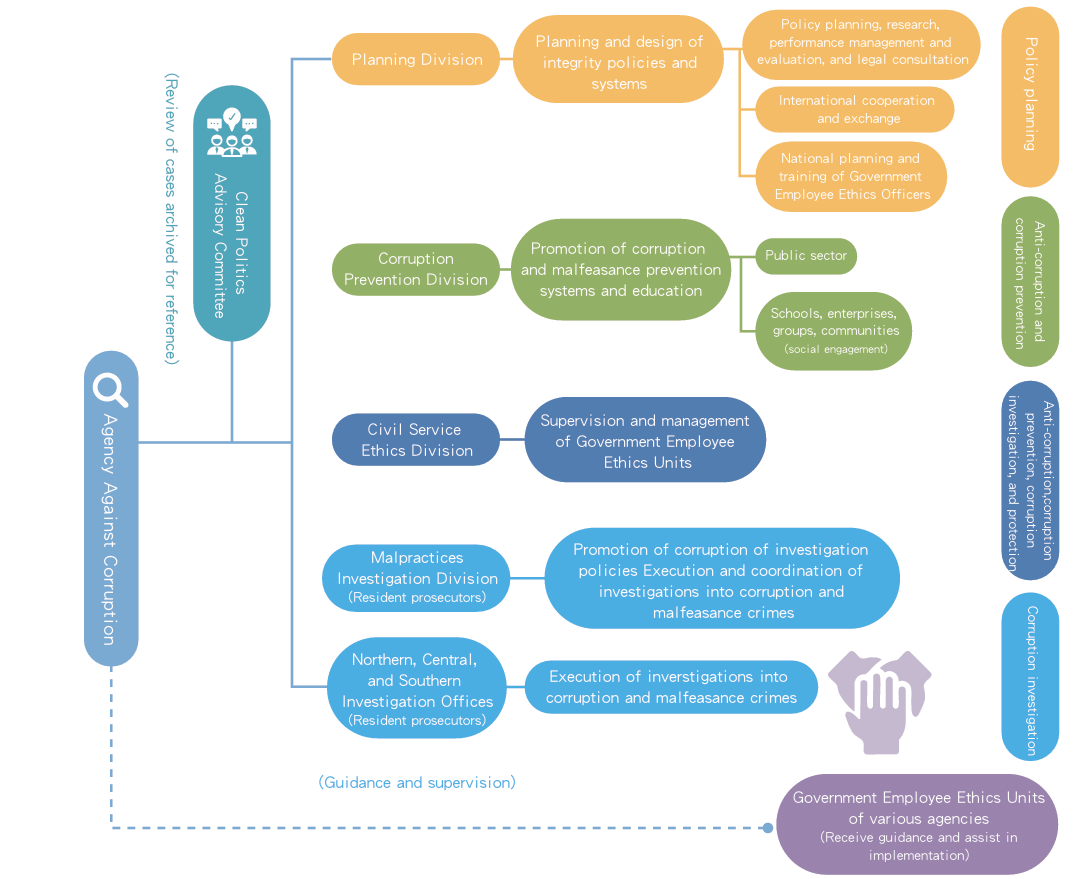
(AAC Organization Chart)
(1) Organization
The agency is in charge of formulating corruption-control policy and fulfilling the functions of anti-corruption education, corruption prevention and corruption investigation. It has a Planning Division, a Corruption Prevention Division, a Malpractices Investigation Division, and a Civil Service Ethics Division, as well as three investigation offices for northern, central and southern Taiwan, totaling seven operational units. Besides, it has three supporting offices in charge of secretarial , personnel and accounting affairs, respectively. The size of its statuary staff is 240. They work along with the civil service ethics officials deployed in the various government organizations across the nation to promote clean politics.
(2) Functional responsibilities
a. Planning Division
- Planning, implementation, management, and evaluation of the Agency's annual administration plan, medium-term administration plan, and individual plans.
- Planning and research of the government's integrity policies and systems.
- Management and evaluation of integrity measures.
- Contact, coordination, exchange, and implementation of international integrity and mutual legal assistance affairs.
- Consultation on regulations, orders, administrative rules, and interpretations.
- Assistance in administrative disputes and state compensation cases.
- Research and compilation of regulations and manuals on integrity work.
- Comprehensive planning, proposal, and implementation of the organization of Government Employee Ethics Units in government agencies nationwide, as well as the appointment, transfer, performance evaluation, reward, and punishment of their personnel.
- Policy planning, analysis, formulation, and implementation of congressional liaison and media relations.
- Other general planning matters.
| UNCAC | Integrity Awards |
| International Affairs |
b. Corruption Prevention Division
- Formulation, implementation, and coordination of laws, systems, and measures for preventing corruption.
- Corruption prevention review and auditing of government agencies and public institutions.
- Promotion, interpretation, and case review of the Act on Recusal of Public Servants Due to Conflicts of Interest and the Act on Property-Declaration by Public Servants.
- Formulation, implementation, and coordination of the Integrity and Ethics Directions for Civil Servants.
- Promotion, planning, and implementation of anti-corruption and integrity education for government agencies, public institutions, the public, communities, schools, enterprises, and organizations.
- Other matters related to preventing corruption and malfeasance.
| Government Procurement Integrity Platform | Integrity and Ethics Directions |
| Property Declaration | Conflict of Interests |
c. Malpractices Investigation Division
- Formulation, implementation, and coordination of laws, systems, and measures for corruption investigation.
- Execution, supervision, coordination, management, and evaluation of investigations into corruption and malfeasance or related crimes.
- Rewards and protection for those who report corruption and malfeasance or related crimes.
- Implementation and supervision of administrative corruption investigation.
- Other matters related to corruption investigations.
d. Civil Service Ethics Division
- Management and evaluation of the annual work plan of Government Employee Ethics Units.
- Performance evaluation of Government Employee Ethics Units.
- Supervision of corruption and malfeasance prevention by Government Employee Ethics Units.
- Review, supervision, analysis, and investigation of corruption and malfeasance or related criminal cases handled by Government Employee Ethics Units.
- Implementation, management, and evaluation of the protection of official classified information by Government Employee Ethics Units.
- Ethics affairs related to the Ministry of Justice.
- Other prevention and investigation matters related to Government Employee Ethics Units.
e. Secretarial Office
- Handling of briefings and proceedings.
- Management of official seals, documents, and archives.
- Management of cashier, property, maintenance, procurement, and other affairs.
- Management of workers (including technicians and drivers).
- Planning, implementation, and management of information services.
- Matters beyond the scope of responsibilities of other sections and offices.
f.Personnel Office
Responsible for personnel matters of the Agency.
g. Accounting Office
Responsible for the Agency's annual budget, accounting and statistics.
h. Northern, Central, and Southern Investigation Offices
- Evidence gathering, analysis, and investigation of corruption and malfeasance or related crimes.
- Other investigations related to corruption and malfeasance or related crimes.